
She may have been a bonnie wee lass on the outside, but on the inside she was a powerhouse of spirit and spunk…. a magnitude ten on the feisty scale. Mom Robertina immigrated to Canada from Northern Scotland with her parents after WWI, arriving just in time for the Great Depression. Her parents, known as Muth and Pap to their children and grandchildren, shared stories that did not dwell on hardship, poverty, or losses; but rather, their narratives were themed around their gratitude for the prosperity of their new land, the value of family, and that survival depends upon how many times you have laughed that day.
Home-baked scones were a typical item in both Muth’s and Mom Robertina’s kitchens. Hand-written recipes with just a simple list of ingredients and a succinct ‘coles notes’ form of method reflect the attitude that anyone who reads this recipe just knows how to make scones and there is no need for details.
Little did I realize that there is a wee bit of a debate going on as to what constitutes an authentic Scottish scone. Eggs, or no eggs – that seems to be the question. Here in North America, we have a coffeehouse knowledge of a scone being somewhat like a muffin, made excessively sweet with copious additions of an assortment of fruits, nuts, and chocolate. The Scots (or the Brits, for that matter) would have none of this. True scones are meant to be simply made with butter, cream, flour, a bit of sugar, and currants. I’m not sure when the addition of eggs became an option; however, my guess is that they were inserted in an attempt to preserve their shelf-life. Given that Pap took scones on his long trek to work each day, I am assuming that Muth had a plan that her batch of scones would last the entire week.
I have presented two recipes for scones. The first, Scottish Scones, uses the authentic ingredients gleaned from a variety of print sources, as well as from conversations with Scottish experts (their words, not mine). The next recipe, Tea Scones, is the recipe found in Mom Robertina’s hand-written recipe book. I have taken the liberty to expand somewhat on her method because I cannot make the same assumptions she made.
The easiest and quickest way to make scones is with the assistance of a food processor with a metal blade; however, like our mothers and grandmothers before us, mixing by hand works just as well. Resist the urge to eat these straight out of the oven – like many things in the kitchen, good things come to those who wait ….let the scones cool a bit before taking the first bite because their flavour and texture improve from a wee bit of a rest. …then serve with clotted cream, or butter, and your favourite preserves.

Scottish Scones
Ingredients:
225 grams (1 ½ cups) all purpose flour
¼ cup (50 g/60 mL) granulated sugar
1 ½ tablespoons (25 mL) baking powder
½ teaspoon (2.5 mL) salt
75 g (1/3 cup) cold unsalted butter, cut into small pieces
¾ cup (185 mL) heavy cream mixed with 1 teaspoon white vinegar or lemon juice
½ cup (125 mL) currants
Egg Wash, plus extra granulated sugar
Tea scones
Ingredients:
300 g (2 cups) all purpose flour
½ cup (100 g/125 mL) granulated sugar
2 teaspoons (10 mL) cream of tartar*
1 teaspoon (5 mL) baking soda*
¾ teaspoon (4 mL) salt
½ cup (115 g/1 stick) unsalted butter (cold) cut into small pieces
½ cup (125 mL) raisins or currants
2 large eggs, slightly beaten
1/3 cup (85 mL) milk
Egg Wash, plus extra granulated sugar
* Two teaspoons of cream of tartar plus 1 teaspoon of baking soda=1 tablespoon baking powder.
Egg Wash: 1 egg yolk + 1 tablespoon of cream or milk
Method for both:
Prep time: 10 minutes Baking Time: 15-20 minutes
Yield: 8 scones
- Whisk together the flour, sugar, leavening ingredients, and salt.
- Cut in the butter until it is in pea-sized lumps. Do not over-mix.
- Stir in liquid ingredients and dried fruit just until blended.
- Turn dough onto a floured surface and shape into a circle, approximately 9 inches in diameter (about ½ inch thick). Place on a greased (or parchment-lined) baking sheet.
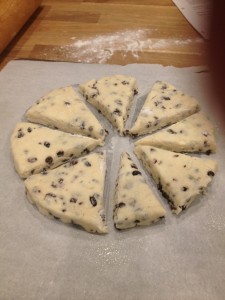
- With a floured knife, cut the dough into 8 pie-shaped wedges. With the floured knife, separate each wedge, pulling them out a little from the circle so that there is some space between each wedge.
- Let the dough rest for 10 minutes as you preheat the oven to 3750F (1900C) and prepare the egg wash (whisk together the egg yolk and milk/cream)
- Brush each scone with the egg wash. Sprinkle some extra granulated sugar over each wedge.


8. Bake for 15-20 minutes at 375 degrees F (1900C), or until the tops are golden.


